jeudi 15 février 2018

Une vie pour l'apprentissage des mathématiques et la pensée informatique

Mathématicien et pionnier des technologies éducatives, Seymour Papert a contribué de façon décisive à l’orientation des recherches sur les environnements informatiques pour l’apprentissage humain (EIAH). Son œuvre est à l’origine d’un courant de recherche international sur l’apprentissage des mathématiques avec lequel la recherche en didactique des mathématiques entretient des relations – que l’on pourrait qualifier de dialectiques – depuis le début des années 80. Victime d’un accident en 2006 à Hanoï, où il était l’invité d’une conférence de la 17° étude ICMI2 sur l'utilisation des technologies numériques dans l'enseignement et l'apprentissage des mathématiques, Seymour Papert a dû brutalement interrompre son activité académique. Il est décédé le 31 juillet 2016.

La revue Recherches en Didactique des mathématiques a souhaité lui rendre hommage, c’est le sens du texte que j'ai proposé pour le numéro 37/2-3 qui vient de paraître. Après avoir évoqué des jalons importants de la vie scientifique de Seymour Papert, ce texte revient sur deux concepts clés, micromonde et constructionisme, qui constituent les piliers fondateurs de son œuvre.

Papert lors de l'ouverture officielle du London Knowledge Lab (début à 14min 15s)

L’héritage de Papert est bien vivant, et l’exploration des voies qu’il a ouvertes est prometteuse. Un Lutin m'a suggéré avec malice de conclure par une citation ; clin d’œil et manière  d’invitation :
"What make our century’s science thinking different from any other century are the ideas associated with computation, computers and information science, and the idea that we should  give children this powerful thing they care about more than anything else, that they ought not to know what goes on inside it - it blows the mind." (Papert 2004)

lundi 18 décembre 2017

Contrôle, preuve et démonstration. Trois régimes de la validation (2)

Mise à jour janvier 2020 :
Balacheff N. (2019) Contrôle, preuve et démonstration. Trois régimes de la validation. In: Pilet J., Vendeira C. (eds.) Actes du séminaire national de didactique des mathématiques 2018 (pp.423-456). Paris : ARDM et IREM de Paris - Université de Paris Diderot.
texte accessible en ligne [ici]

L'enregistrement de l'exposé au séminaire national ARDM de Didactique des mathématiques est disponible. Il suffit pour y accéder de cliquer sur l'image ci-dessous. Le résumé et le diaporama sont accessibles [ici].

http://mc.univ-paris-diderot.fr/videos/MEDIA171207155920637/multimedia/MEDIA171207155920637.mp4

Je répondrai aux questions éventuelles dans le fil de commentaires associé à ce billet.

Références utiles (prochainement complétées) :
Brousseau G. (2000) Que peut-on enseigner en mathématiques à l'école primaire et pourquoi ?  Repères IREM 7-10,  n° 38  Topiques éditions.
Duval R. (1992) Argumenter,démontrer, expliquer. Continuité ou rupture cognitive ? Petit X, 31 pp. 37-61.
DGESco (2008) Raisonnement et démonstration.  Ressources pour les classes de 6e, 5e, 4e, et 3e du collège. EduSCOL. Paris : Ministère de l’éducation nationale.
DGESco (2016) Raisonner. Ressources d'accompagnement du programme de mathématiques (cycle 4). Eduscol. Paris : Ministère de l’éducation nationale, de l’enseignement supérieur et de la recherche. 

samedi 18 novembre 2017

Contrôle, preuve et démonstration. Trois régimes de la validation (1)

Raisonner est l'une des six compétences majeures du socle commun des mathématiques du cycle 4 (années 7, 8 et 9 du cursus français obligatoire). Elle inclut démontrer, c'est-à-dire « utiliser un raisonnement logique et des règles établies (propriétés, théorèmes, formules) pour parvenir à une conclusion » ainsi que « fonder et défendre ses jugements en s’appuyant sur des résultats établis et sur sa maîtrise de l’argumentation. » Démontrer c'est aussi « "donner à voir" les différentes étapes d’une preuve par la présentation, rédigée sous forme déductive, des liens logiques qui la sous-tendent. » des  (DGESco 2016 p.1)

Les mots preuve, démonstration, argumentation sont ainsi utilisés par les textes des programmes de mathématiques et leurs commentaires. Cet usage affirme le caractère central de la démonstration, « moyen mathématique d'accès à la vérité », dans l'apprentissage des mathématiques. Il atteste aussi la difficulté de son enseignement car « [pour] ne pas détourner de la résolution de problèmes les élèves ayant des difficultés à entrer dans les codes de rédaction d’une démonstration, il importe de valoriser les productions spontanées, écrites ou orales, issues des phases de recherche et d’expérimentation (calculs seuls, croquis destinés à comprendre l’exercice, idées de preuve, plan de preuve, etc.). » (DGESco 2016 p.4)

ARDM
J'ai choisi, pour répondre à l'invitation du séminaire national de didactique des mathématiques, d'interroger les avancées de la recherche sur l’apprentissage et l’enseignement de la démonstration et leur capacité à éclairer la mise en œuvre des programmes actuels. Je reviendrai, en introduction, sur le vocabulaire en insistant notamment sur les différents régimes de la validation dans l'activité de l'élève. Puis j'aborderai ces questions dans la problématique de la validation au sens de la théorie des situations didactiques. Les principaux thèmes seront l’articulation entre preuve et connaissance en évoquant brièvement le modèle ck¢, et la relation entre démonstration et argumentation. Une dernière partie portera sur les perspectives ouvertes par les technologies informatiques.


Séminaire national de didactique des mathématiques - ARDM
Paris, 18 novembre 2017 

 
Cliquer [ici] pour obtenir le programme du séminaire national de didactique des mathématiques. Paris, samedi 18 novembre 2017

dimanche 12 novembre 2017

Explanation, proof and mathematical proof - A needed clarification

November 21st update: the final version of Gila Hanna paper “Reflections on proof as explanation” will no longer include the comment which justified this post. However, taking into account this comment was important and the following clarification of the misleading diagram is necessary. I thank Gila for the quality of our exchange and for giving me the opportunity of this clarification.


 For about 30 years, I have used the Venn diagram reproduced here, without noticing how seriously it could be misleading once separated from its context. I realized that when reading recently Gila Hanna “Reflections on proof as explanation” (Hanna 2016). She  referred to this diagram in support to the claim “If one were to take the position that an explanation is simply a deductive argument, then all proofs would automatically be explanations”. This is the consequence of a quick reading of the paper where I used this diagram (Balacheff, 2010, p.130), but with a text making explicit the meaning of the three sets and the corresponding perspective.

In the said 2010 paper, entitled “Bridging proving and knowing in mathematics”, I postulated the following: “the explaining power of a text (or non-textual ‘discourse’) is directly related to the quality and density of its roots in the learner’s (or even mathematician’s) knowing.” I then added explicitly that such a text or discourse is “an “explanation” of the validity of a statement from the subject’s own perspective.” The following intended to position the three expressions: explanation, proof and mathematical proof.
“What is produced first is an “explanation” of the validity of a statement from the subject’s own perspective. This text can achieve the status of proof if it gets enough support from a community that accepts and values it as such. Finally, it can be claimed as mathematical proof if it meets the current standards of mathematical practice. So, the keystone of a problématique of proof in mathematics (and possibly any field) is the nature of the relation between the subject’s knowing and what is involved in the ‘proof’.” (my today emphasis)
Setting this framework was cautious enough not to restrict mathematical proof to logic in a narrow sense but to “the current standards of mathematical practice”. I must recognize that using such a diagram was a bit risky, and misleading for a quick reading.

I first developed this approach at the end of the 80s. Taking the perspective of the learner’s knowing, I chosen the word “explanation” instead of “argumentation” to account for the genuine effort of the learner to respond to the “why” a statement or a result is valid based on his or her “existing knowledge” – as Gila Hanna refers to it; the ground of the claim for validity being the functional organization and semantic value of the statements as opposed to what Duval called their epistemic value. Indeed, the ultimate aim of an explanation is to modify the epistemic value of the statement or result which initially is best qualified as a conjecture. Transforming one's own personal explanation of the validity of a statement into a proof (or a mathematical proof) is a complex process not always successful nor possible. When reading a proof, the reverse process necessary to get from it an explanation of the claimed validity is in itself an issue. It means constructing the links between the content and structure of the proposed proof and the reader’s own existing knowledge. It is in this manner that I understand the issue of the explaining power of a proof.

Hanna G. (2016) reflections on proof as explanation. In: 13th International Congress on Mathematical Education. Hamburg, 24-31 July 2016 [https://www.researchgate.net/publication/316975364]

mardi 13 juin 2017

A note on Bourbaki's definition of function, in the context of Anna Sfard characterization of conceptions


The Ana Sfard influential article published in Educational Studies in Mathematics in 1991 on the dual nature of mathematical conceptions is still important to read. I recently came back to this paper while working on the conceptions of function using of the modelling framework cK¢.  Indeed there is a difference in our approaches since her approach of Ana Sfard, defining a conception as the mental counterpart of a concept, the latter being the official form of a "mathematical idea". This meaning of "concept" seems close to the usual meaning of the French word " savoir", and far from the one adopted for cK¢ -- but this is another discussion. On the other hand both approaches have in common the recognition of methodological constraints: we have no choice in order to make sense of the formation of abstract (mathematical) objects but to describe them in terms of such external characteristics as student’s behaviours, attitudes and skills (Sfard 1991 p.19).

Anna Sfard distinguishes two types of conception, operational and structural. The former is characterized in terms of processes, algorithms and actions, while the latter is "treating mathematical notions as if they referred to some abstract object" (ibid. pp.3-4). The methodological constraints gives an advantage to evidencing operational conceptions but make it delicate for structural conceptions. Following Anna Sfard, a critical indicator of the presence of a structural conception is the capacity to recognize an idea "at a glance" and "to manipulate it as a whole, without going into details" (ibid. p.4).  This emergence of a structural conception would be empirically reflected by the "attempts at translating  operational intuition into structural definition" (ibid. p.15).  Anna Sfard sees the most achieved state of development of the conception of function in "the now widely accepted, purely structural Bourbaki's definition. This simple description presented function as a set of ordered pairs and made no reference whatsoever to any kind of computational  process." (ibid. p.15)

The initial ambition of the founders of the Bourbaki group [1], was to write a treatise for the teaching of calculus (incidentally claimed to be accessible to a not so smart student obliged to work alone [2]). There is no question about the structural character of the Bourbaki’s conception of function; however its characterization by Anna Sfard (ibid. p.5 Fig.1) as "Set of pairs (Bourbaki 1934)" is a bit short. Indeed, ordered pair should have been written here instead of pair, but there is more to say. The definition of function appears in the Set theory book (ST) where it emerges, so to say, from the definition of functional relation which is a restriction of the definition of relation

"Let R be a relation in C  [equalitarian theory]. The relation "(x)R and there exists at most one x such that R" is denoted by "there exists exactly one x such that R". If this relation is a theorem in C, R is said to be a functional relation in x in the theory C." (ST p.48)

Then function is further defined as a set of ordered pairs under a specific condition: 

"A graph F is said to be a functional graph if for each x there is at most one object which corresponds to x under F (Chapter l, § 5, no. 3). A correspondence f= (F, A, B) is said to be a function if its graph F is a fonctional graph and if its source A is equal to its domain pr1F. In other words, a correspondence f = (F, A, B) is a function if for every x belonging to the source A of f the relation (x, y)F is functional in y (Chapter l, § 5, no. 3); the unique object which corresponds to x under f is called the value of f at the element x of A, and is denoted by f(x) (or fx, or F(x), or Fx)." (ST p.81)

By the way, the contemporary teacher may interpret the graph as a curve, and the condition as the perpendicular line criterion which is often associated to the characterization of function in Anglo-Saxon curricula. In an informal way, Bourbaki accepts here to aggregate functional relation and functional graph in one single concept: "Throughout this series we shall often use the word "function" in place of "functional graph"." (ST p.82).

Eventually, Bourbaki comes back to all definitions in the “Summary of results” of the Set theory book, with the idea of fixing terms which will be used in the remainder of the series of the treatise. He adds the following caveat as a footnote:  "The reader will not fail to observe that the "naïve" point of view taken here is in direct opposition to the "formalist" point of view taken in Chapters 1 to IV. Of course, this contrast is deliberate, and corresponds to the different purposes of this Summary and the rest of the volume." (ST p.347). The following definition of function is proposed in this context:

"Let E and F be two sets, which may or may not be distinct. A relation between a variable element x of E and a variable element y of F is called a functional relation in y if, for all xE, there exists a unique yF, which is in the given relation with x. We give the name of function to the operation which in this way associates with every element xE the element yF which is in the given relation with x; y is said to be the value of the function at the element x, and the function is said to be determined by the given functional relation." (ST p.351) 

This definition bridges the naïve (in the Bourbaki sense) understanding of function with its formal characterization. However, the word "variable", which didn't appear before in the book, is here an adjective which meaning is fixed in the first section of the Summary of results:  "variable element" means "arbitrary element" (ST p.347). By denoting "the operation", the word "function" keeps some contact with what Anna Sfard (1991 p.15) refers to as "its intuitive origin". It is close to the prototypical example of operational conception she gives in the [Fig.1] of her article, quoting Richard Skemp: "well defined method of getting from one system to another" (or computational process).

The Bourbaki construction provides an example of an explicit link between the Anna Sfard structural and operational conceptions of function. From a different perspective, it illustrates well the claim that “the terms "operational" and "structural" refer to inseparable, though dramatically different, facets of the same thing." (Sfard 1991 p.9). In this quick record of the Bourbaki enterprise to define "function", we see the coherent and explicit integration of different connotation: functional relation, functional graph, operation. In naïve words, they are facets of an object which are unified by the formal construction.  This notion of object can be easily related to that of high-level interiorization proposed by Anna Sfard.

samedi 30 avril 2016

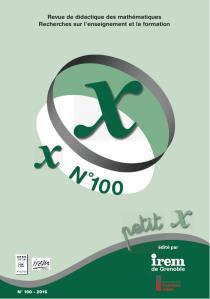
Petit x, le centième numéro : une nouvelle impulsion


La revue Petit x est née en 1983 dans le sillage de Grand N. Ce « Journal pour les enseignants de mathématiques et de sciences physique du premier cycle de l’enseignement secondaire » avait l’ambition « d'être à la fois un moyen de formation continue et un outil pour la pratique quotidienne de la classe ». Pour réaliser cet objectif, il s'est attaché à réunir dans un même cadre éditorial des textes issus des laboratoires de recherche et des textes issus de la classe, assemblant pratiques et réflexions. Au fil des numéros cette politique s'est affirmée, la revue est devenue un espace pour une communication plus directe de la recherche vers l’enseignement. Sa qualité lui vaut d'avoir été retenue comme une « revue d’interface » par l’agence nationale pour la recherche (HCERES). Ainsi la revue Petit x est-elle devenue un support de publication respecté et recherché, notamment par les jeunes chercheurs. Cette évolution est clairement affirmée par le nouveau sous-titre qui apparait sur la couverture du centième numéro : « Revue de didactique des mathématiques – recherche sur l’enseignement et la formation ».   [lire le texte complet]

vendredi 22 janvier 2016

Linking ck¢ and the Toulmin model


http://authors.elsevier.com/a/1SP-K2cWY-QmZm
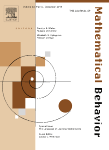
An original theoretical as well as methodological aspect of Bettina Pedemonte PhD work, was to use the Toulmin schema in relation with a knowledge model in the framework of the Theory of Didactical Situations. We have recently revisited this work and produced  a synthesis of this important outcome. This has led to a paper recently published in the Journal of Mathematical Behavior, in which we analyze students’ conceptions in geometrical problem-solving and their relations to proving. We show how students’ conceptions strongly impact the argumentation activity and the construction of a proof. This is illustrated by analyzing two pairs of students’ argumentations and proofs taken from a set of data collected from a teaching experiment. The use of the Toulmin's model enriched with the ck¢ model allows to elicit the complexity of a cognitive analysis of argumentation and proof that accounts for the students’ knowledge system. Toulmin's model is useful to select those elements in the argumentation that are part of students’ conceptions while ck¢ allows us to see the role they have inside the argumentation.
[click on the cover to get a free copy within the 50 coming days]