mardi 13 juin 2017

A note on Bourbaki's definition of function, in the context of Anna Sfard characterization of conceptions


The Ana Sfard influential article published in Educational Studies in Mathematics in 1991 on the dual nature of mathematical conceptions is still important to read. I recently came back to this paper while working on the conceptions of function using of the modelling framework cK¢.  Indeed there is a difference in our approaches since her approach of Ana Sfard, defining a conception as the mental counterpart of a concept, the latter being the official form of a "mathematical idea". This meaning of "concept" seems close to the usual meaning of the French word " savoir", and far from the one adopted for cK¢ -- but this is another discussion. On the other hand both approaches have in common the recognition of methodological constraints: we have no choice in order to make sense of the formation of abstract (mathematical) objects but to describe them in terms of such external characteristics as student’s behaviours, attitudes and skills (Sfard 1991 p.19).

Anna Sfard distinguishes two types of conception, operational and structural. The former is characterized in terms of processes, algorithms and actions, while the latter is "treating mathematical notions as if they referred to some abstract object" (ibid. pp.3-4). The methodological constraints gives an advantage to evidencing operational conceptions but make it delicate for structural conceptions. Following Anna Sfard, a critical indicator of the presence of a structural conception is the capacity to recognize an idea "at a glance" and "to manipulate it as a whole, without going into details" (ibid. p.4).  This emergence of a structural conception would be empirically reflected by the "attempts at translating  operational intuition into structural definition" (ibid. p.15).  Anna Sfard sees the most achieved state of development of the conception of function in "the now widely accepted, purely structural Bourbaki's definition. This simple description presented function as a set of ordered pairs and made no reference whatsoever to any kind of computational  process." (ibid. p.15)

The initial ambition of the founders of the Bourbaki group [1], was to write a treatise for the teaching of calculus (incidentally claimed to be accessible to a not so smart student obliged to work alone [2]). There is no question about the structural character of the Bourbaki’s conception of function; however its characterization by Anna Sfard (ibid. p.5 Fig.1) as "Set of pairs (Bourbaki 1934)" is a bit short. Indeed, ordered pair should have been written here instead of pair, but there is more to say. The definition of function appears in the Set theory book (ST) where it emerges, so to say, from the definition of functional relation which is a restriction of the definition of relation

"Let R be a relation in C  [equalitarian theory]. The relation "(x)R and there exists at most one x such that R" is denoted by "there exists exactly one x such that R". If this relation is a theorem in C, R is said to be a functional relation in x in the theory C." (ST p.48)

Then function is further defined as a set of ordered pairs under a specific condition: 

"A graph F is said to be a functional graph if for each x there is at most one object which corresponds to x under F (Chapter l, § 5, no. 3). A correspondence f= (F, A, B) is said to be a function if its graph F is a fonctional graph and if its source A is equal to its domain pr1F. In other words, a correspondence f = (F, A, B) is a function if for every x belonging to the source A of f the relation (x, y)F is functional in y (Chapter l, § 5, no. 3); the unique object which corresponds to x under f is called the value of f at the element x of A, and is denoted by f(x) (or fx, or F(x), or Fx)." (ST p.81)

By the way, the contemporary teacher may interpret the graph as a curve, and the condition as the perpendicular line criterion which is often associated to the characterization of function in Anglo-Saxon curricula. In an informal way, Bourbaki accepts here to aggregate functional relation and functional graph in one single concept: "Throughout this series we shall often use the word "function" in place of "functional graph"." (ST p.82).

Eventually, Bourbaki comes back to all definitions in the “Summary of results” of the Set theory book, with the idea of fixing terms which will be used in the remainder of the series of the treatise. He adds the following caveat as a footnote:  "The reader will not fail to observe that the "naïve" point of view taken here is in direct opposition to the "formalist" point of view taken in Chapters 1 to IV. Of course, this contrast is deliberate, and corresponds to the different purposes of this Summary and the rest of the volume." (ST p.347). The following definition of function is proposed in this context:

"Let E and F be two sets, which may or may not be distinct. A relation between a variable element x of E and a variable element y of F is called a functional relation in y if, for all xE, there exists a unique yF, which is in the given relation with x. We give the name of function to the operation which in this way associates with every element xE the element yF which is in the given relation with x; y is said to be the value of the function at the element x, and the function is said to be determined by the given functional relation." (ST p.351) 

This definition bridges the naïve (in the Bourbaki sense) understanding of function with its formal characterization. However, the word "variable", which didn't appear before in the book, is here an adjective which meaning is fixed in the first section of the Summary of results:  "variable element" means "arbitrary element" (ST p.347). By denoting "the operation", the word "function" keeps some contact with what Anna Sfard (1991 p.15) refers to as "its intuitive origin". It is close to the prototypical example of operational conception she gives in the [Fig.1] of her article, quoting Richard Skemp: "well defined method of getting from one system to another" (or computational process).

The Bourbaki construction provides an example of an explicit link between the Anna Sfard structural and operational conceptions of function. From a different perspective, it illustrates well the claim that “the terms "operational" and "structural" refer to inseparable, though dramatically different, facets of the same thing." (Sfard 1991 p.9). In this quick record of the Bourbaki enterprise to define "function", we see the coherent and explicit integration of different connotation: functional relation, functional graph, operation. In naïve words, they are facets of an object which are unified by the formal construction.  This notion of object can be easily related to that of high-level interiorization proposed by Anna Sfard.

samedi 30 avril 2016

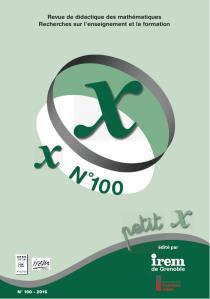
Petit x, le centième numéro : une nouvelle impulsion


La revue Petit x est née en 1983 dans le sillage de Grand N. Ce « Journal pour les enseignants de mathématiques et de sciences physique du premier cycle de l’enseignement secondaire » avait l’ambition « d'être à la fois un moyen de formation continue et un outil pour la pratique quotidienne de la classe ». Pour réaliser cet objectif, il s'est attaché à réunir dans un même cadre éditorial des textes issus des laboratoires de recherche et des textes issus de la classe, assemblant pratiques et réflexions. Au fil des numéros cette politique s'est affirmée, la revue est devenue un espace pour une communication plus directe de la recherche vers l’enseignement. Sa qualité lui vaut d'avoir été retenue comme une « revue d’interface » par l’agence nationale pour la recherche (HCERES). Ainsi la revue Petit x est-elle devenue un support de publication respecté et recherché, notamment par les jeunes chercheurs. Cette évolution est clairement affirmée par le nouveau sous-titre qui apparait sur la couverture du centième numéro : « Revue de didactique des mathématiques – recherche sur l’enseignement et la formation ».   [lire le texte complet]

vendredi 22 janvier 2016

Linking ck¢ and the Toulmin model


http://authors.elsevier.com/a/1SP-K2cWY-QmZm
An original theoretical as well as methodological aspect of Bettina Pedemonte PhD work, was to use the Toulmin schema in relation with a knowledge model in the framework of the Theory of Didactical Situations. We have recently revisited this work and produced  a synthesis of this important outcome. This has led to a paper recently published in the Journal of Mathematical Behavior, in which we analyze students’ conceptions in geometrical problem-solving and their relations to proving. We show how students’ conceptions strongly impact the argumentation activity and the construction of a proof. This is illustrated by analyzing two pairs of students’ argumentations and proofs taken from a set of data collected from a teaching experiment. The use of the Toulmin's model enriched with the ck¢ model allows to elicit the complexity of a cognitive analysis of argumentation and proof that accounts for the students’ knowledge system. Toulmin's model is useful to select those elements in the argumentation that are part of students’ conceptions while ck¢ allows us to see the role they have inside the argumentation.
[click on the cover to get a free copy within the 50 coming days]

jeudi 10 décembre 2015

Serious games, conjugaison de jeux d'apprentissage et de jeux de la connaissance

La notion de jeu est l'une des premières composantes de la construction de modèles dans le cadre de la théorie des situations didactiques (TSD):
"Modéliser une situation d'enseignement consiste à produire un jeu spécifique du savoir visé, entre différents sous-systèmes : le système éducatif, le système élève, le milieu, etc." Mais, écrit Brousseau (1986/ in 1998 p.80), "Il ne s'agit pas de décrire précisément ces sous-systèmes autrement que par les relations qu'ils entretiennent dans le jeu."
- Au regard de la connaissance : "le jeu doit être tel que la connaissance apparaisse sous la forme choisie, comme la solution, ou le moyen d'établir la stratégie optimale [...]" (ibid. p.80)
- Au regard de l'activité d'enseignement :"le jeu doit permettre de représenter toutes les situations observées dans les classes (sinon les déroulements particuliers) même les moins satisfaisantes dès lors qu'elles parviennent à faire apprendre à des élèves une forme de savoir visé. Il doit pouvoir engendrer toutes les variantes, même les plus dégénérées. Elles seront obtenues par le choix des valeurs de certaines variables caractéristiques de ce jeu." (ibid. p.81)
Ainsi le jeu, source de motivations, peut par ses règles, ses représentations et ses stratégies,  accompagner l'apprenant vers la connaissance enjeu de l'apprentissage.

Le diaporama ci-dessous a servi de support à un exposé introductif à une discussion lors d'un séminaire de l'équipe MeTAH en juin 2010 sur le thème des jeux sérieux. Il met en relation la problématique du jeu au sens de la TSD et la problématique des jeux sérieux.


lundi 2 novembre 2015

Research in didactics of mathematics, first release of a corpus of terms and definitions

The first version of a corpus of terms and definitions used by research in didactics of mathematics (didactique des mathématiques) has been released [here]. This first version is mainly the result of a reading of the journal Recherches en didactique des mathématiques. The next step will add what will be obtained from the reading of the associated series. 
Meanwhile, I will add translations found in books and journals (e.g. Educational Studies in Mathematics). I count with the collaboration 2.0 of colleagues from the international community. Depending on my resources and my energy, the project is still to achieve a synthesis including an analysis of the genesis and evolutions of our field of research, including a multidisciplinary and an international perspective.

Corpus des termes de la recherche en didactique des mathématiques - V1

Une première version du corpus des termes et expressions de la recherche en didactique des mathématiques est maintenant disponible [ici]. Cette première version est essentiellement constitué du résultat d'une lecture de la revue Recherches en didactique des mathématiques. La prochaine étape (V2) a pour objectif de compléter ce corpus avec ce qui sera obtenu de la lecture de la collection associée.
Parallèlement, j'ajouterai les traductions que je relèverai dans des livres et revues, notamment Educational Studies in Mathematics ; je compte pour cela sur la collaboration 2.0 des collègues de la communauté internationale. Le projet est toujours, selon mes ressources et mon énergie, de réaliser une synthèse incluant une analyse de la genèse et des évolutions de notre domaine, incluant une perspective pluridisciplinaire et internationale.

lundi 14 septembre 2015

What would the Theory of Didactical Situations mean to my research? A workshop


Math Ed. Doctoral Colloquium at CINVESTAV ... in relation to my lecture, I will run a workshop, interactive and collaborative, on the possible contribution of the Theory of didactical situation (TSD) to the design and implementation of a research project in mathematics education.   Questions or comments on this post are welcome (in Spanish, French or English), I will consider them during the workshop. Here is the presentation of the workshop:

Choosing a theoretical framework to address a research question in mathematics education is one of the difficult decision PhD students must take. This workshop, as a follow up of Nicolas Balacheff lecture, will offer an opportunity to present and discuss PhD research projects from a theoretical perspective. The TSD has several integrated dimensions which allows to build bridges with other frameworks such as constructivism, epistemology, situated learning, collaborative learning and educational technology as well. The discussion will allow to deepen the theoretical issues and understand how the TSD can contribute to the shaping of a research project. 

A suggested format is : two minutes presentation of the PhD topic, then five minutes to present an issue which could be either theoretical, methodological or related to the identification and presentation of results. Five to six different projects could be presented  within the 90mn workshops.